SSH, current by default
Post-quantum key exchange first, strict key exchange, no compression. Every algorithm in use is rated in plain words, so you can see what a connection really negotiated.
In development for Windows and Linux
Open an SSH session, reach an older switch over Telnet, or plug into its serial console. Keep your local shell in the next tab.
Download coming soon Explore features
$88.42 once · Lifetime updates included
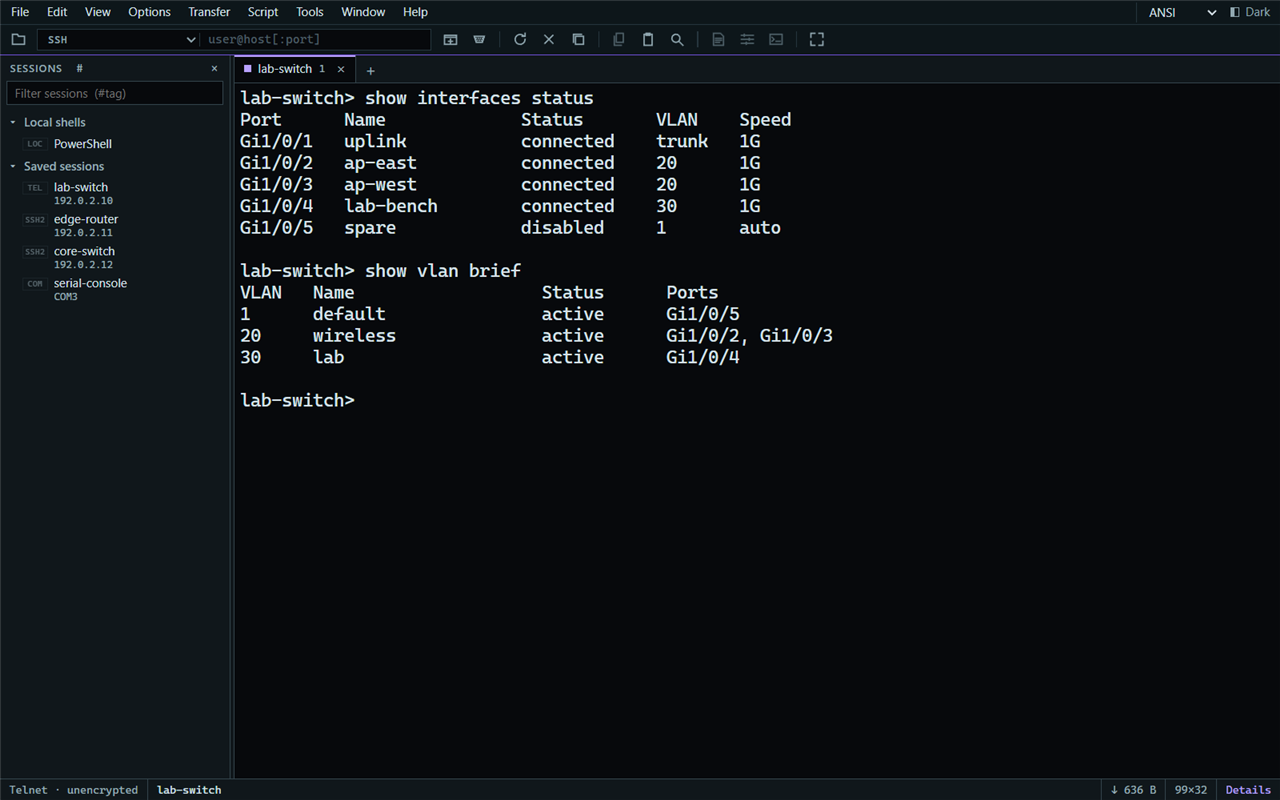
Switch layouts while your shells and connections stay open.
| Layout | Workspace |
|---|---|
| Classic | Keep saved sessions, named tab groups and connection details within reach. |
| Terminal | Give one shell the window. Search your open tabs, saved hosts and actions with Ctrl+Shift+P. |
| Tiled | Watch several sessions side by side. Split, resize or zoom a pane while the others keep running. |
Post-quantum key exchange first, strict key exchange, no compression. Every algorithm in use is rated in plain words, so you can see what a connection really negotiated.
Switches and routers that only speak older algorithms can be allowed one session at a time, with a clear warning first and a marker on the tab afterwards.
A port finder that ranks the likely console cables, speed detection for when the label fell off, and Send Break where you need it.
A host that goes quiet, a link that dies, a firewall that resets you: each ends the session with a sentence that says which. Nothing waits without a limit.
Text with line breaks is shown in an editable preview before it is sent, because each line runs as it arrives. A stray Enter cannot send it.
Written in Rust. Output is flow-controlled from the wire to the screen, so a busy session applies backpressure when the window falls behind.
Figures from our own test runs on a development machine, over loopback, in a debug build. How they were taken.
rheaCRT takes its name from Rhea, mother of the gods in Greek mythology. Its logo shows a lion wearing a crown shaped like a city wall. CRT stands for cathode-ray tube, the display behind the green glow of early terminals.